The 30-second takeaway
- Keep approved scope and durable workflow state outside model reasoning.
- Give isolated workers task-scoped tools and require independent verification.
- Release only an authorized artifact with evidence tied to its exact version.
AI coding agents can produce changes faster than an organization can review, integrate, and operate them. The leadership challenge is to build a delivery system that turns that output into dependable business capability, with clear ownership of scope, evidence, and release decisions.
The architecture below proposes a way to do that: combine AWS AI-DLC lifecycle coordination with Superpowers-guided engineering execution, managed model access, and an independent delivery pipeline. It is a reference design for an integration that must be implemented and validated. It does not describe an out-of-the-box AWS product or a completed deployment.
Start with the operating model
AWS AI-DLC organizes AI-assisted development around Inception, Construction, and Operations, with human participation in critical decisions and persistent project context. That provides a useful structure for turning business intent into reviewed work and carrying the resulting context forward.
Superpowers provides composable practices for coding agents, including design, implementation planning, test-driven development, debugging, and review. In this proposal, those practices guide an agent's work inside an approved task.
Both approaches address parts of the development process. Combining them requires an explicit contract: the lifecycle controller owns phase transitions and approved scope; the worker owns implementation within that scope; the delivery system owns independent verification and release. A skill file can guide behavior, but permissions and deployment authority must be enforced by the platform.
The reference architecture
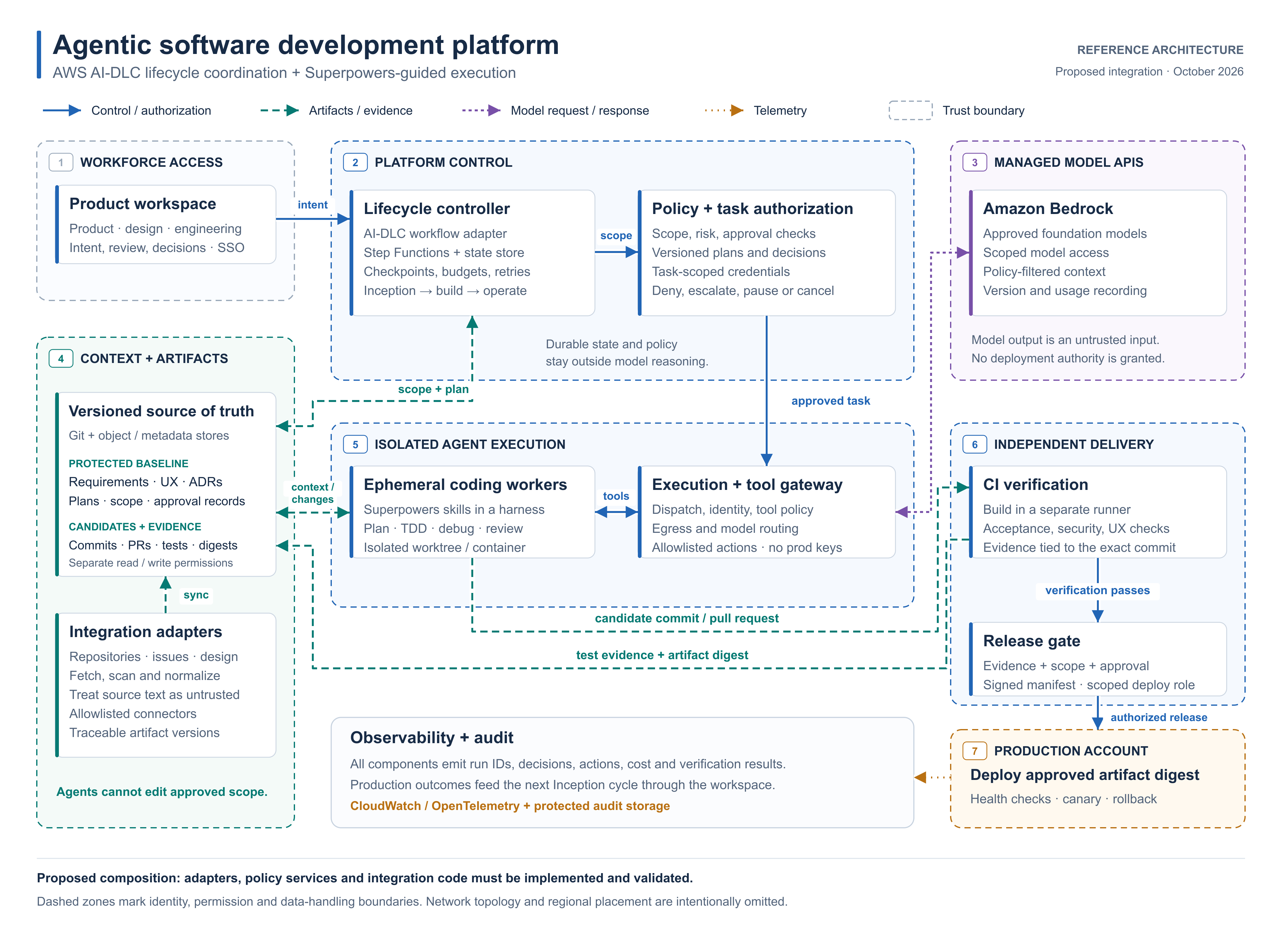
The diagram separates seven trust zones and distinguishes four kinds of traffic: control and authorization, artifacts and evidence, model requests and responses, and telemetry. Read the numbered zones alongside the component descriptions below. The complete PNG is available above at its original resolution.
1. Workforce access: where intent and decisions enter
The product workspace brings product, design, and engineering into one decision surface. People supply the business problem, review alternatives, and approve consequential changes through authenticated access. Each decision should identify the decision maker, the version of the proposal, and the scope being authorized.
This is where a request becomes a bounded assignment: a desired outcome, acceptance criteria, constraints, and a named owner. A conversation provides context; a versioned decision creates a durable record.
2. Platform control: durable state and authorization
The lifecycle controller tracks phases, checkpoints, budgets, retries, and task state. A workflow adapter translates AI-DLC activities into platform transitions. In an AWS implementation, Step Functions and a state store are possible building blocks; this diagram does not imply that installing AI-DLC provisions either.
The policy service evaluates scope, risk, and required approvals before a task is dispatched. It can deny an action, request review, pause a run, or cancel it. Durable workflow state and authorization decisions remain outside model reasoning so a model response cannot silently advance the lifecycle or rewrite the approval history.
3. Managed model APIs: scoped reasoning services
Amazon Bedrock is the proposed model access layer. The execution gateway routes requests to approved models, limits the supplied context, and records model identity and usage. Bedrock IAM controls govern access to service operations; application policy must also govern what data and tools a particular task may use.
Model output remains untrusted input. It may propose code, actions, or a plan, but the model API receives no deployment authority. Content filtering can reduce some risks; it cannot replace permission checks, independent tests, or accountable review.
4. Context and artifacts: separate the baseline from candidates
A versioned source of truth holds requirements, UX decisions, architecture records, plans, and approval records. Candidate changes live separately as commits, pull requests, test results, and artifact digests. This separation lets a worker propose a scope change without giving it permission to edit the approved baseline.
Integration adapters bring in repository, issue, and design context. They should fetch, scan, normalize, and label that material with its source and version. Treat text from connected systems as evidence to interpret, not as an automatic grant of authority. Read and write permissions need distinct enforcement.
5. Isolated execution: temporary workers, bounded tools
Ephemeral coding workers receive the approved task, necessary context, and task-scoped access. Each worker follows the selected Superpowers practices and returns candidate changes with evidence. It should be disposable: durable decisions belong in the platform, and completed artifacts belong in the source of truth.
The execution and tool gateway mediates identity, tool use, network egress, model routing, and cancellation. An isolated Git worktree separates changes but is not a security boundary by itself. Use an appropriate container or virtual-machine boundary, restricted credentials, and network controls for the risk of the work. Workers should have no production deployment keys.
6. Independent delivery: verify the exact candidate
A separate CI runner checks the candidate against acceptance, security, and UX requirements. Evidence must identify the exact commit and resulting artifact. A passing test report for an earlier revision is insufficient when a later revision is about to ship.
The release gate evaluates that evidence alongside approved scope and required authorization. A signed manifest can bind the approved artifact digest to the release decision. Signing alone does not establish quality: trusted build execution, protected signing credentials, and signature verification are also part of the design.
7. Production: deploy the approved artifact
The production account receives the approved artifact through a scoped deployment role. It should deploy that artifact rather than rebuilding an unreviewed variation. Health checks, canary exposure where appropriate, and rollback behavior are part of the release contract.
Operational results then inform the next Inception cycle. Incidents, adoption, reliability, and actual business outcomes should change the backlog and acceptance criteria.
Follow one change through the platform
- Capture intent. A product owner describes an outcome and constraints. The workspace records the reviewed requirements and decisions.
- Authorize a task. The controller selects the lifecycle step. Policy binds permission to the approved scope, task identity, tools, and budget.
- Prepare context. Adapters supply versioned source material. The worker can read the approved baseline and write candidate changes through separately controlled paths.
- Execute and inspect. A temporary worker plans, implements, tests, and reviews within its assignment. Tool and model requests pass through the gateway.
- Produce a candidate. The worker returns a commit or pull request with its evidence. It cannot declare its own output authorized for production.
- Verify independently. CI runs against that candidate and records results and artifact digests. A changed commit invalidates evidence that no longer applies.
- Release and learn. The gate authorizes the verified artifact, deployment checks its health, and operational evidence feeds the next decision cycle.
Control flow answers “Who may do what now?” Artifact flow answers “What changed, and what evidence supports it?” Keeping those questions distinct makes the system easier to audit and recover when something fails.
Make trust boundaries enforceable
The dashed zones in the diagram describe identity, permission, and data-handling boundaries. They are not a complete network topology. An implementation still needs account and network placement, regional and data-residency decisions, encryption, retention rules, identity federation, and a secrets model.
Three tests are especially useful during design review. Can a worker change its own approved scope? Can untrusted source text cause a tool to use a stronger identity? Can an artifact reach production without evidence tied to its digest? A “yes” identifies a gap in the proposed control system.
Threat modeling should also cover malicious repository content, compromised dependencies, leaked credentials, prompt injection, and changes to the policy service itself. Approvals need to bind to a specific version and expire or be re-evaluated when relevant scope, code, policy, or evidence changes.
Design for failure and cost from the beginning
Agent runs will encounter unavailable services, ambiguous requirements, failed tests, and invalid model output. The controller should distinguish a safe retry from a repeated side effect. Give tasks stable identifiers, make consequential operations idempotent where possible, cap retries, and expose pause and cancellation as real platform actions.
Budget limits belong at the run and task level, alongside timeouts, tool-call limits, and model-routing policy. A cheaper model call does not necessarily create a cheaper accepted change if it increases rework or review effort. AI FinOps provides the broader framework for this economic accountability.
CloudWatch or an OpenTelemetry-based pipeline can carry run identifiers, actions, duration, cost, and verification results into the observability layer. Protect audit storage and define what must be retained. Avoid indiscriminately logging secrets or sensitive prompt content. The goal is a defensible record of decisions and observable actions, not dependence on hidden model reasoning.
Adopt it in controlled increments
Begin with one well-understood repository and a low-risk change class. Keep releases manually authorized while validating task isolation, context quality, independent checks, and recovery behavior. Establish a baseline for delivery lead time, review effort, rework, escaped defects, and cost per accepted change.
Then increase scope only where evidence supports it. Test denied actions and credential boundaries as deliberately as successful builds. Exercise rollback and cancellation. Pin workflow and skill versions, review their updates, and validate the integration again when behavior changes.
The implementation backlog should explicitly include the AI-DLC adapter, policy service, execution gateway, context adapters, evidence schema, and release integration. Existing tools can supply building blocks, but the composition in this diagram still requires engineering.
The leadership decision
An agentic development platform is an operating commitment. Product leaders must define outcomes, engineering leaders must own quality and integration, and platform teams must make authority and evidence enforceable.
The useful measure is the dependable change that reaches customers: its value, lead time, risk, and total cost. More generated code is only an intermediate output. Build the platform around that distinction, and agent autonomy can grow with the organization's ability to verify and govern its results.