The 10x Workforce: How AI Is Redefining Human Potential
- scottshultz87
- Jun 4
- 24 min read
Abstract:
Over the past three decades, the Internet connected the world, mobile technology placed computing power in every pocket, and cloud computing made enterprise-scale capabilities accessible to organizations of all sizes. Artificial Intelligence represents the next major platform shift—one that differs fundamentally from those that came before it. Rather than simply improving access to information, technology, or infrastructure, AI has the potential to augment human cognitive capability itself.
This article explores why AI may be the most significant workforce transformation in a generation, examining how it is reshaping knowledge work across industries and functions. From research, analysis, writing, software development, and decision-making to recruiting, legal operations, customer service, and enterprise technology, AI is enabling individuals and organizations to operate with unprecedented speed, scale, and effectiveness.
The discussion moves beyond common narratives of workforce replacement and instead focuses on workforce amplification—the emergence of the “10x professional” and the “10x enterprise.” It examines the evolution from AI assistants to prompt engineering, reusable organizational skills, intelligent agents, and AI-orchestrated workflows that combine human expertise with machine intelligence.
The article also addresses the responsibilities that accompany AI adoption, including governance, security, privacy, transparency, bias mitigation, and ethical oversight. Finally, it provides a practical roadmap for leaders, managers, employees, and organizations seeking to navigate the transition from experimentation to enterprise-scale adoption.
The central argument is simple: the future is not fewer people. The future is more capable people. Organizations that learn to effectively combine human judgment, creativity, and empathy with AI-powered intelligence, automation, and scale will define the next era of competitive advantage.
Why AI May Be the Most Important Workforce Shift in the past 30+ Years
Over the past three decades, the Internet connected the world, mobile technology put computing in every pocket, and cloud computing made enterprise-scale technology available to organizations of every size. Artificial intelligence represents the next great platform shift—not because it gives us access to more information, but because it helps us think, learn, create, analyze, and execute at a scale previously unimaginable.
The Last Thirty Years of Technology Transformation

Every generation believes its technologies are revolutionary. Most are not. A select few fundamentally reshape how society works.
Over the past century, organizations have experienced several transformational technology eras:
Era | Primary Impact |
Mainframe | Centralized computing |
Personal Computer | Individual productivity |
Internet | Global connectivity |
Mobile | Always-on access |
Cloud | Infinite scalability |
AI | Cognitive augmentation |
Each transformation followed a remarkably similar pattern.

When email emerged, many organizations continued relying on fax machines and physical mail. When online commerce appeared, traditional retailers viewed it as a niche channel. When smartphones arrived, many professionals saw them as consumer gadgets rather than business tools. When cloud computing emerged, countless IT organizations argued that critical systems would never leave corporate data centers.
History proved otherwise. Organizations that embraced these shifts gained enormous advantages. Organizations that resisted eventually adapted—or became irrelevant. Artificial Intelligence now stands at a similar inflection point. Yet AI differs from every previous technology revolution in one critical way.

The Internet amplified access to information. Mobile amplified access to technology. Cloud amplified access to computing power. AI amplifies human intellectual capability itself. That distinction may make it the most consequential workforce transformation of our lifetime. “The story of AI is not primarily about replacing humans. It is about creating more capable humans.”
The Internet Revolution: Democratizing Information
Before the Internet, information was scarce. Finding expertise required libraries, consultants, printed publications, or institutional access. The Internet fundamentally altered that equation. Search engines placed humanity’s collective knowledge within reach of anyone with a connection. Businesses suddenly operated within a global marketplace. Consumers gained unprecedented transparency. Companies such as Amazon, eBay, and Google emerged as entirely new categories of enterprise.

Industries transformed:
Retail became e-commerce
Banking became digital
Media became online
Marketing became data-driven
Customer service became self-service
Knowledge workers experienced similar changes. Research that once required days could be completed in hours.
The Mobile Revolution: Computing Everywhere
The next transformation moved computing from desks to pockets.The smartphone became the most rapidly adopted technology in human history.
Consumers gained instant access to:
Navigation
Communication
Commerce
Entertainment
Banking
Productivity
Entire industries emerged. Organizations such as Uber, Airbnb, and DoorDash were built around mobile-first experiences. The workforce changed dramatically. Employees became continuously connected. Remote work became viable. Customer expectations shifted toward immediacy. The mobile era wasn’t merely about smaller computers. It fundamentally changed consumer behavior.
The Cloud Revolution: Computing Without Limits
The third major shift transformed enterprise technology itself. Cloud computing eliminated many traditional constraints:
Infrastructure procurement
Hardware management
Geographic limitations
Capacity planning bottlenecks
Platforms such as Amazon Web Services, Microsoft Azure, and Google Cloud made enterprise-grade capabilities accessible to organizations of virtually any size.
The effects were profound:
IT Transformation
Infrastructure became software
Automation replaced manual operations
DevOps emerged
Development Transformation
Faster releases
Continuous deployment
Global scalability
Business Transformation
Lower capital expenditure
Faster innovation
Global expansion
Cloud amplified organizational capability. But it still required humans to determine what work should be performed. AI changes that equation.
The AI Revolution: Amplifying Intelligence
Artificial Intelligence represents something fundamentally different. Previous technology waves primarily enhanced physical or informational capability. AI enhances cognitive capability.
Today’s AI ecosystem includes:
Large Language Models
Reasoning Models
Computer Vision
Speech Recognition
Generative Media
Autonomous Agents
For the first time, organizations possess technology capable of:
Reading
Writing
Summarizing
Analyzing
Reasoning
Researching
Planning
Coordinating
Not perfectly. Not autonomously. But at increasingly useful levels.
This changes the economics of knowledge work.
The Rise of the 10x Professional
The term “10x engineer” has existed for decades. AI expands that concept beyond software development. The emerging reality is the 10x professional.

Research
A market analyst previously spending two weeks gathering information can now:
Analyze competitors
Synthesize industry reports
Generate summaries
Identify patterns
Build comparative frameworks
in hours rather than weeks. The human still directs the effort. AI accelerates execution.
Writing
Knowledge work is largely communication. Professionals spend enormous amounts of time creating:
Emails
Reports
Presentations
Policies
Documentation
Executive briefings
AI dramatically reduces first-draft effort. Instead of starting from a blank page, professionals begin with a structured draft. This shifts value creation from typing to thinking.
Analysis
Financial analysts can:
Build scenarios
Interpret trends
Generate hypotheses
Identify anomalies
at unprecedented speed. Executives gain faster decision support.
Managers gain better visibility. Organizations gain greater agility.
Software Development
Software engineering may be one of the earliest examples of AI augmentation at scale. Modern AI systems assist with:
Code generation
Unit testing
Refactoring
Documentation
Architecture reviews
Security analysis
Developers increasingly spend less time writing boilerplate code and more time solving business problems.
Learning
Perhaps the most underrated capability is personalized learning. AI functions as:
Tutor
Coach
Research assistant
Technical mentor
Writing advisor
Knowledge acquisition accelerates dramatically. This benefits average performers.
It benefits high performers even more.
Historically, top performers leveraged superior information. Today they leverage superior AI.
The Emerging Divide: AI-Native vs AI-Resistant Professionals
Every technology revolution creates winners and laggards. AI appears likely to do the same.

Historical Parallels
Typists resisting word processors
Retailers resisting e-commerce
IT teams resisting cloud computing
The issue was never technology itself. The issue was adaptation.
The consequence is not immediate replacement. The consequence is widening productivity gaps. Career progression increasingly favors those who learn to collaborate with intelligent systems. Fortunately, every professional can choose to become AI-native.
AI Is a Tool. Humans Determine the Outcome.
Electricity powered hospitals, businesses and home. The Internet enabled education and cybercrime. Social media connected communities and spread misinformation. Technology is neutral.
Humans determine outcomes.
Positive AI Applications
AI is already transforming industries by augmenting human expertise, accelerating decision-making, reducing administrative burden, and enabling new levels of innovation. From healthcare and education to accessibility and scientific research, AI is helping professionals focus more of their time on high-value work while improving outcomes, expanding access, and accelerating discovery.

AI has the potential to create more equitable, personalized, and effective learning experiences by helping educators meet the unique needs of every learner.
Risks
Organizations Must Address the Risks of AI Responsibly. While AI creates tremendous opportunities, organizations must also recognize and proactively manage the risks that accompany powerful technologies. Success with AI requires balancing innovation with governance, security, and ethical responsibility.

Fraud
AI can dramatically increase the scale and sophistication of fraudulent activities.
Examples include:
Automated phishing campaigns that appear highly personalized
AI-generated scams designed to mimic legitimate communications
Synthetic identities used to bypass verification processes
Financial fraud through fake documents, invoices, and transactions
Social engineering attacks enhanced through publicly available data
Organizations must strengthen identity verification, monitoring, employee awareness training, and fraud detection capabilities.
Deepfakes
AI can generate highly realistic audio, video, and images that are difficult to distinguish from authentic content.
Potential risks include:
Executives appearing to make statements they never made
Fabricated customer testimonials
Fake emergency communications
Brand reputation damage
Misinformation campaigns targeting employees, customers, or investors
As deepfake quality improves, organizations will need verification processes, digital watermarking, authentication technologies, and employee education programs.
Manipulation and Misinformation
AI can be used to influence opinions, behaviors, and decisions at unprecedented scale.
Examples include:
Automated creation of misleading content
Hyper-targeted persuasion campaigns
Manipulated social media conversations
False information presented as fact
Coordinated influence operations
Organizations must promote transparency, validate information sources, and establish policies for responsible AI-generated content.
Security Concerns
AI introduces new cybersecurity risks while simultaneously becoming a critical security tool.
Challenges include:
AI-assisted cyberattacks
Automated vulnerability discovery
Credential theft and phishing enhancement
Prompt injection attacks against AI systems
Data poisoning and model manipulation
Unauthorized access to AI agents and workflows
Organizations should implement:
Zero Trust security architectures
Strong access controls
AI-specific security testing
Continuous monitoring
Secure model deployment practices
Human oversight for high-risk actions
Privacy Concerns
AI systems often require access to large volumes of data, creating significant privacy considerations.
Key concerns include:
Exposure of sensitive customer information
Inadvertent disclosure of confidential business data
Collection of more data than necessary
Regulatory compliance risks
Cross-border data handling challenges
Unauthorized use of personal information
Organizations should establish:
Clear data governance frameworks
Data minimization practices
Consent and transparency mechanisms
Encryption and data protection controls
Compliance with privacy regulations
Regular privacy impact assessments
Emerging Risks
Forward-looking organizations are also evaluating:
Intellectual Property Risks
Use of copyrighted material in training data
Ownership of AI-generated content
Protection of proprietary information
Brand and trademark misuse
Regulatory and Compliance Risks
Rapidly evolving AI regulations
Industry-specific compliance requirements
Auditability and explainability expectations
Documentation and governance obligations
Bias and Fairness
Discriminatory outcomes
Unequal treatment of individuals or groups
Inaccurate recommendations or decisions
Lack of transparency in automated processes
Workforce and Organizational Risks
Overreliance on AI-generated outputs
Reduced critical thinking and verification
Inconsistent AI usage across teams
Skills gaps and change resistance
The greatest risk is not using AI. The second greatest risk is using AI without governance.
Organizations that successfully balance innovation, security, privacy, transparency, and human oversight will be positioned to realize AI’s benefits while minimizing unintended consequences.
Responsible AI Principles

Successful organizations implement strong foundations to ensure AI is deployed safely, responsibly, and effectively.
Human Oversight
AI should support human decision-making, not replace human accountability.
Keep humans involved in high-impact decisions.
Validate AI-generated recommendations and outputs.
Maintain clear ownership and accountability.
Goal: Human judgment remains the final authority.
Transparency
Users should understand when and how AI is being used.
Disclose AI involvement where appropriate.
Communicate capabilities and limitations.
Maintain explainability and auditability.
Goal: Build trust through visibility and clarity.
Governance
Establish policies, standards, and accountability for AI usage.
Define ownership and decision rights.
Implement risk management processes.
Standardize AI deployment and monitoring.
Goal: Enable safe and scalable AI adoption.
Security
Protect AI systems, data, and integrations from misuse and attack.
Enforce access controls and authentication.
Secure models, prompts, and data.
Continuously monitor for threats.
Goal: Safeguard AI and enterprise assets.
Privacy Controls
Protect personal and sensitive information.
Limit data collection and exposure.
Enforce data protection measures.
Comply with applicable regulations.
Goal: Use data responsibly and securely.
Ethical Review
Evaluate the broader impact of AI on people and organizations.
Assess fairness and bias.
Consider societal and workforce impacts.
Ensure responsible deployment decisions.
Goal: Align AI use with organizational values and ethics.
The objective should be workforce amplification. Not workforce reduction. AI is not the player. You are.
AI Adoption for Beginners
Most organizations begin their AI journey by using AI as a personal productivity tool. Over time, they progress toward embedding AI into workflows, business processes, and eventually enterprise operations. Each level builds upon the previous one, increasing both the value delivered and the organizational impact.

Level 1: AI Assistant User
At the foundational level, individuals use tools such as ChatGPT, Claude, and Gemini to assist with writing, research, brainstorming, and everyday problem-solving. The focus is on improving personal productivity and gaining familiarity with AI capabilities.
Level 2: Power User
As users become more proficient, they move beyond simple conversations and begin leveraging structured prompts, reusable templates, and repeatable workflows. This creates more reliable and consistent outcomes while reducing the time required to perform common tasks.
Level 3: Knowledge Worker Augmentation
Organizations begin embedding their own knowledge, expertise, and processes into AI through Custom GPTs, Claude Projects, Claude Skills, and enterprise knowledge bases. AI evolves from a general-purpose assistant into a specialized organizational resource capable of delivering context-aware insights and recommendations.
Level 4: Automation
The focus shifts from assisting work to performing work. Platforms such as Microsoft Copilot, Zapier, Make, and n8n enable organizations to automate repetitive tasks, orchestrate workflows, and eliminate manual effort across business functions. Productivity gains become measurable at both the individual and team levels.
Level 5: AI-Orchestrated Work
At the highest level of maturity, organizations deploy multiple AI agents that collaborate, coordinate tasks, and execute complex workflows under human oversight. AI becomes an integrated operational capability that augments entire departments and business processes, enabling significant improvements in speed, scale, and efficiency.
Key Principle
The goal is not to jump immediately to autonomous AI. The most successful organizations progress through a deliberate maturity curve—first learning how to use AI, then standardizing it, embedding organizational knowledge, automating routine work, and ultimately orchestrating AI-enabled workflows at enterprise scale. Each stage compounds the value of the previous one, creating a foundation for sustained productivity and innovation.
AI Tools and Techniques
This version is more executive-focused, creates a stronger narrative progression from prompting → platforms → skills → agents, and better aligns with the message that AI is an organizational capability rather than simply a technology tool.

Prompt Engineering: The New Professional Skill
As artificial intelligence becomes embedded in everyday business operations, the ability to effectively direct AI is emerging as one of the most important professional competencies of the modern workplace.
Just as spreadsheets became essential for finance, email transformed communication, and presentations became critical for leadership, prompt engineering is rapidly becoming a foundational skill for knowledge workers across every function.
Many people assume AI performance is primarily determined by the underlying model. In reality, the difference between mediocre and exceptional outcomes is often the quality of the instructions provided.
Poor Prompt
“Write a report.”
Effective Prompt
“Act as a CFO. Analyze the attached quarterly financial results. Identify the three largest risks, three largest opportunities, and provide a board-ready executive summary limited to 500 words.”
The second prompt provides context, direction, constraints, and a clear definition of success. As a result, the output is more relevant, actionable, and aligned with business objectives.
Effective prompts typically follow a common format, but can vary based on the task. Common prompt framework approaches include:
RTF: Role – Task – Format (simplist and most common)
One of the simplest and most widely used frameworks.
Role
Task
Format
Example:
Act as a cybersecurity consultant. Assess the attached architecture. Provide findings in a risk matrix.
Best for:
Quick business requests
Daily AI interactions
New users
The R-O-C-C-A-F-E Framework
This framework is simple enough for beginners while being powerful enough for executives.
Role → Who should the AI be?
Objective → What are you trying to accomplish?
Context → What information should be considered?
Constraints → What limitations or requirements must be followed?
Audience → Who is the output for?
Format → How should the response be structured?
Examples → What does good look like?
Example
Role: Act as a CFO.
Objective: Analyze quarterly financial performance.
Context: Attached Q2 financial statements and forecast.
Constraints: Limit to 500 words. Focus on material business impacts.
Audience: Board of Directors.
Format: Executive summary, top 3 risks, top 3 opportunities.
Examples: Similar to a public company board briefing.
CARE Framework
Context
Action
Result
Examples
Example:
Context: We are preparing for a board meeting.
Action: Analyze the attached operating results.
Result: Identify strategic risks and opportunities.
Examples: Use a McKinsey-style executive summary.
Best for:
Strategy work
Consulting
Business analysis
CRISPE Framework
A favorite among advanced prompt engineers.
Capacity (Role)
Request
Insight (Context)
Specifics (Constraints)
Personalization (Audience)
Examples
Best for:
Complex knowledge work
Executive reporting
Specialized expertise
COSTAR Framework
One of the most popular enterprise frameworks.
Context
Objective
Style
Tone
Audience
Response Format
Example:
Context: Annual planning process.
Objective: Create a technology strategy.
Style: Executive consulting.
Tone: Professional and concise.
Audience: CEO and Board.
Response Format: PowerPoint outline.
Best for:
Corporate communications
Executive presentations
Leadership teams
Executive AI Prompt Template
For most business situations, a single template works exceptionally well:
WHO
Who should the AI act as?
WHAT
What specific outcome do you want?
WHY
Why does this matter?
CONTEXT
What information should be considered?
CONSTRAINTS
What rules must be followed?
AUDIENCE
Who is the deliverable for?
FORMAT
How should the answer be structured?
SUCCESS CRITERIA
What does a great answer look like?
The comparison is increasingly clear:
Managing AI is becoming remarkably similar to managing people.
High-performing employees require clear goals, relevant context, defined expectations, and feedback. AI systems operate much the same way. The quality of direction directly influences the quality of outcomes.
Organizations that invest in AI literacy and prompting skills will consistently outperform organizations that rely on ad hoc interactions and inconsistent usage patterns.
Prompt engineering is not simply a technical skill.
It is rapidly becoming a leadership skill.
AI Platforms, Skills, Agents, and the Future of Work
As organizations mature in their AI adoption journey, they move beyond simple conversations with AI and begin building reusable expertise, connected workflows, and intelligent agents that augment entire business functions.
Today’s leading AI platforms—including ChatGPT, Claude, Gemini, and Perplexity—provide the foundation for this transformation. A table of features for today's most common tools is outlined below.
Capability | ChatGPT | Claude | Gemini | Perplexity |
General-Purpose AI Assistant | ✓ | ✓ | ✓ | ✓ |
Writing & Content Creation | ✓✓✓ | ✓✓✓ | ✓✓ | ✓ |
Long-Form Analysis | ✓✓ | ✓✓✓ | ✓✓ | ✓ |
Research & Information Gathering | ✓✓ | ✓✓ | ✓✓ | ✓✓✓ |
Source Citation & References | ✓ | ✓ | ✓ | ✓✓✓ |
Strategic Thinking & Business Analysis | ✓✓✓ | ✓✓✓ | ✓✓ | ✓ |
Coding & Software Development | ✓✓✓ | ✓✓✓ | ✓✓ | ✓ |
Data Analysis | ✓✓✓ | ✓✓ | ✓✓ | ✓ |
Document Review | ✓✓ | ✓✓✓ | ✓✓ | ✓ |
Multimodal (Text, Image, Audio, Video) | ✓✓✓ | ✓✓ | ✓✓✓ | ✓ |
Image Generation | ✓✓✓ | Limited | Limited | Limited |
Deep Research Workflows | ✓✓✓ | ✓✓ | ✓✓ | ✓✓✓ |
Custom AI Assistants | Custom GPTs | Projects & Skills | Gems | Spaces |
Knowledge Base Integration | ✓ | ✓✓✓ | ✓✓ | ✓ |
Agentic Workflows | ✓✓✓ | ✓✓✓ | ✓✓ | Limited |
Enterprise Controls | ✓✓✓ | ✓✓✓ | ✓✓✓ | ✓ |
Microsoft Ecosystem Integration | ✓✓✓ | Limited | Limited | Limited |
Google Ecosystem Integration | Limited | Limited | ✓✓✓ | Limited |
Real-Time Web Search | ✓ | ✓ | ✓ | ✓✓✓ |
Team Collaboration Features | ✓✓ | ✓✓✓ | ✓✓ | ✓ |
API & Developer Ecosystem | ✓✓✓ | ✓✓✓ | ✓✓ | ✓ |
While each platform has unique strengths, they are increasingly becoming the primary interface through which organizations access knowledge, automate work, accelerate decision-making, and scale expertise.
AI Platforms: Different Strengths, Common Destination
Organizations are discovering that different platforms excel in different areas.
ChatGPT
Particularly strong for:
General business productivity
Custom GPT development
Data analysis
Software development
Content creation
Workflow automation
Agent orchestration
Claude
Particularly strong for:
Long-form analysis
Strategic thinking
Document review
Enterprise knowledge management
Claude Projects and Skills
Complex reasoning tasks
Gemini
Particularly strong for:
Google Workspace integration
Enterprise productivity workflows
Search and research
Multimodal content creation
Collaboration and knowledge access
Perplexity
Particularly strong for:
Research and discovery
Source validation
Competitive intelligence
Market analysis
Real-time information retrieval
The most advanced organizations increasingly utilize multiple AI platforms, selecting the right capability for each use case rather than standardizing on a single solution.
The long-term competitive advantage will not come from selecting the “best” AI model. It will come from building the strongest AI-enabled operating model.
Skills: Institutionalizing Expertise
As AI adoption expands, organizations begin converting individual expertise into reusable organizational capabilities.
Whether implemented as Claude Skills, Custom GPTs, Gemini Gems, enterprise assistants, agent workflows, or curated prompt libraries, the objective remains the same:
Capture expertise once. Reuse it thousands of times.
Examples include:
Contract review and risk assessment
Architecture and cybersecurity reviews
Financial analysis and forecasting
Board and executive report generation
Product requirements development
Marketing content creation
Policy and compliance reviews
Vendor evaluations
Technology due diligence
Strategic planning support
Benefits of Skills
Consistent outputs across teams
Higher-quality analysis and recommendations
Preservation of institutional knowledge
Faster employee onboarding
Reduced dependency on individual experts
Increased scalability across the enterprise
Historically, organizational knowledge resided primarily in people.
Skills enable organizations to transform expertise into reusable corporate assets.
This shift is significant. Knowledge becomes less dependent on who is available and more dependent on what the organization has codified. Organizations that systematically capture and scale expertise will create advantages that compound over time.
Power Up AI: How Agents Move From Knowledge to Action
The next evolution extends beyond answering questions and generating content.
AI agents are capable of performing work.
Unlike traditional software systems that execute predefined instructions, agents can reason, adapt, coordinate, and execute within defined boundaries.
They can:
Plan complex tasks
Research information from multiple sources
Analyze and synthesize findings
Execute approved actions
Coordinate with other agents
Monitor systems and workflows
Generate reports and recommendations
Escalate issues requiring human intervention
The distinction is important. Traditional software automates tasks. AI agents increasingly automate workflows.
Rather than functioning solely as tools, they begin operating as digital teammates that support employees by handling repetitive, administrative, and analytical work.
Digital Teammates in Action

While much of the discussion around AI focuses on chatbots and content generation, the greatest long-term value will come from AI agents embedded directly into business processes. These agents function as digital teammates, assisting employees by performing research, analysis, coordination, monitoring, and routine execution activities that consume significant amounts of time today.
Rather than replacing human expertise, AI agents allow employees to focus on judgment, creativity, strategy, relationship building, and decision-making. By automating repetitive tasks and accelerating information processing, organizations can improve productivity, reduce operational friction, and enable teams to operate at a scale previously impossible.
The opportunity extends across virtually every business function. From recruiting and finance to operations, customer service, technology, and executive leadership, AI agents can augment human capabilities, improve consistency, and help organizations make faster, more informed decisions.
The following examples illustrate how AI agents are beginning to transform work across the enterprise.
The Workforce Transformation Ahead
The evolution of enterprise technology is accelerating. The progression is becoming increasingly clear:

For decades, technology primarily served as a tool that people used. Increasingly, technology is becoming a collaborator that people work alongside. This represents one of the most significant shifts in knowledge work since the introduction of the internet.
The organizations that realize the greatest value will not simply deploy AI tools. They will build AI-enabled operating models that combine:
Human expertise
Reusable organizational knowledge
AI-powered workflows
Autonomous agents
Strong governance and oversight
The result is not simply automation. The result is amplified human capability.
Key Principle
The Future Is More Capable People
Throughout history, transformative technologies have consistently expanded human capability. The Internet transformed access to information. Mobile devices put computing power in every pocket. Cloud computing made enterprise-scale technology available to organizations of all sizes.
Artificial Intelligence represents the next major shift.
Much of the public discussion focuses on automation and workforce disruption, but the larger opportunity is far more compelling. The future is not fewer people. The future is more capable people.
AI platforms such as ChatGPT, Claude, Gemini, and Perplexity provide the foundation for this transformation. These systems enable individuals to access knowledge, generate content, conduct research, analyze information, and solve problems faster than ever before.
However, technology alone does not create value.
The first differentiator is prompt engineering—the ability to effectively communicate with AI. Just as leaders achieve better outcomes through clear direction, context, and expectations, professionals who learn to guide AI effectively will consistently achieve superior results.
The next evolution is the creation of Skills. Skills transform expertise from something that exists only within individuals into reusable organizational assets. Best practices, methodologies, analytical frameworks, and institutional knowledge can be captured once and applied consistently across teams, improving quality, reducing variability, and preserving knowledge at scale.
Beyond Skills are AI Agents. Agents move beyond answering questions and generating content. They plan, research, analyze, coordinate, monitor, and execute work within defined boundaries. Agents transform knowledge into action, allowing organizations to automate routine activities while enabling employees to focus on judgment, creativity, innovation, and relationship building.
Together, these capabilities create a powerful progression:
AI Platforms provide access to intelligence.
Prompt Engineering enables effective collaboration with AI.
Skills capture and scale expertise.
Agents automate and orchestrate work.
The result is not simply greater efficiency. It is a fundamental increase in organizational capability.
Individuals become more productive.
Teams become more effective.
Organizations operate with a level of speed, intelligence, consistency, and scale that was previously unattainable.
The organizations that learn to partner with AI will not replace human potential.
They will multiply it.
The 10x Enterprise with AI
Example 1: 10x HR Recruiting and Talent Acquisition

Recruiting is one of the most promising applications of AI within the enterprise. Talent acquisition teams often spend significant time reviewing applications, coordinating interviews, validating qualifications, communicating with candidates, and consolidating feedback. AI has the potential to automate many of these administrative activities, allowing recruiters and hiring managers to focus more of their time on candidate engagement, relationship building, and hiring decisions.
In a future-state recruiting workflow, AI can assist throughout the candidate lifecycle.
Candidate Intake
AI can rapidly process large volumes of applications by:
Ingesting resumes and applications
Extracting relevant skills and experience
Identifying certifications and qualifications
Standardizing candidate information
Creating structured candidate profiles
This can significantly reduce manual review effort while improving consistency and helping recruiters identify qualified candidates more quickly.
Candidate Scoring and Alignment
AI can assist in evaluating candidate fit by:
Matching experience against job requirements
Validating certifications and credentials
Assessing skill alignment
Identifying transferable experience
Highlighting potential strengths and gaps
Rather than replacing recruiter judgment, AI can help prioritize candidate review and surface insights that may otherwise be overlooked.
Professional Presence Analysis
Organizations may choose to evaluate publicly available professional information to gain a broader understanding of candidate experience.
Examples include:
LinkedIn profiles
Professional portfolios
Publications and presentations
Open-source contributions
Industry participation and certifications
Any use of public information must be conducted responsibly and in compliance with applicable laws, privacy requirements, ethical guidelines, and organizational policies.
Interview Preparation
AI can help improve interview quality and consistency by generating:
Behavioral interview questions
Technical assessments
Role-specific scenarios
Follow-up questions based on candidate experience
Structured evaluation criteria
This can help ensure a more consistent and objective interview process across hiring teams.
Interview Orchestration
AI can also reduce administrative workload by coordinating:
Scheduling
Candidate communications
Interview reminders
Feedback collection
Interview panel coordination
These activities consume significant recruiter time and are well suited for automation.
AI-Assisted Interviews
Emerging capabilities may allow AI to support interview processes through:
Dynamic questioning
Real-time transcription
Interview summarization
Competency mapping
Structured feedback generation
However, organizations must exercise caution. Communication style, confidence, accent, tone, speaking patterns, and other behavioral signals should never serve as the sole basis for hiring decisions. These factors can introduce bias and may not accurately reflect a candidate’s capabilities or potential.
Human judgment remains essential.
Final Selection
The most important principle is that AI should support hiring decisions—not make them. AI can provide:
Candidate insights
Qualification summaries
Interview feedback consolidation
Risk indicators
Decision-support recommendations
Recruiters and hiring managers remain responsible for evaluating candidates, exercising judgment, considering organizational fit, and making final hiring decisions.
Business Value
When implemented responsibly, AI-enabled recruiting can deliver substantial business benefits:
Reduced time-to-hire
Improved recruiter productivity
Faster candidate screening
More consistent evaluations
Better candidate experiences
Increased scalability during hiring surges
Improved visibility into talent pipelines
Enhanced decision support for hiring managers
The objective is not to replace recruiters. The objective is to enable recruiters to spend less time on administrative activities and more time identifying, engaging, and hiring exceptional talent.
Key Principle
AI can help organizations find talent faster and more efficiently, but people hire people.
The most successful recruiting organizations will use AI to augment human expertise, improve consistency, and accelerate decision-making while maintaining strong governance, privacy protections, bias controls, transparency, and human oversight throughout the hiring process.
Example 2: 10x Legal Department
Legal departments manage vast amounts of information, including contracts, policies, regulations, compliance requirements, litigation documents, and corporate records. Much of this work is highly repetitive, document-intensive, and time-sensitive, making it an ideal candidate for AI augmentation.
Rather than replacing legal professionals, AI has the potential to reduce administrative burden, accelerate document review, improve consistency, and enable attorneys to focus more of their time on strategic legal guidance, negotiation, risk management, and business partnership.
Contract Intake
AI can automatically process incoming legal documents by:
Classifying contract types
Routing documents to appropriate teams
Identifying priority reviews
Extracting key metadata
Initiating approval workflows
This can significantly reduce manual intake effort and improve response times.
Clause Extraction and Analysis
AI can rapidly identify and summarize critical contract provisions, including:
Term and renewal clauses
Indemnification language
Liability limitations
Confidentiality requirements
Data privacy provisions
Termination conditions
This allows legal teams to review large volumes of contracts more efficiently while maintaining consistency.
Risk Scoring
AI can compare contracts against organizational standards and highlight:
Non-standard language
Missing protections
Compliance concerns
Elevated business risk
Potential negotiation points
Attorneys remain responsible for legal interpretation and final decisions, but AI can help focus attention on the highest-risk areas.
Regulatory Review
Organizations operate within increasingly complex regulatory environments. AI can assist by:
Identifying applicable regulations
Mapping obligations to contract language
Highlighting compliance gaps
Monitoring regulatory changes
Surfacing relevant legal precedents and guidance
This can improve compliance readiness while reducing research effort.
Redlining and Drafting Support
AI can accelerate contract negotiations by:
Suggesting alternative language
Drafting proposed revisions
Generating standard clauses
Comparing contract versions
Summarizing negotiation changes
Legal professionals review and approve all modifications, ensuring appropriate legal judgment remains in the process.
Obligation Tracking
Many organizations struggle to manage contractual obligations after agreements are signed. AI can help track:
Reporting requirements
Service-level commitments
Notice periods
Deliverable deadlines
Compliance obligations
This reduces the risk of missed commitments and contractual breaches.
Renewal and Lifecycle Management
AI can improve contract lifecycle visibility by monitoring:
Renewal dates
Auto-renewal provisions
Termination windows
Pricing adjustments
Vendor performance milestones
This enables proactive management rather than reactive responses.
Knowledge Retrieval
One of the most powerful applications of AI is transforming legal repositories into searchable knowledge assets. Legal teams can instantly access:
Historical agreements
Approved clauses
Prior negotiations
Regulatory guidance
Internal legal policies
Precedent-based recommendations
Instead of searching through thousands of documents, attorneys can retrieve relevant information in seconds.
Business Value
When implemented responsibly, AI can deliver significant value to legal departments:
Faster contract review cycles
Reduced administrative workload
Improved compliance monitoring
Greater consistency in legal analysis
Enhanced risk identification
Better contract lifecycle visibility
Faster access to institutional knowledge
Increased attorney productivity
Key Principle
The objective is not fewer attorneys.
The objective is attorneys spending less time searching, reviewing, organizing, and tracking documents—and more time advising the business, mitigating risk, negotiating complex matters, and providing strategic legal counsel.
AI can process information at scale.
Attorneys provide judgment, interpretation, advocacy, and accountability.
The greatest value emerges when both work together.
Example 3: 10x Software Product Delivery

Software development is one of the domains most likely to be transformed by AI. Unlike many business functions that leverage AI for individual tasks, software delivery presents an opportunity to embed AI across the entire product lifecycle—from initial idea through ongoing operations and continuous improvement.
AI can help organizations accelerate delivery, improve quality, reduce technical debt, strengthen security, and enable teams to focus more on innovation and customer value. The greatest impact will not come from AI writing code alone, but from AI augmenting every stage of product development.
Product Strategy
AI can help product and business leaders identify opportunities and make more informed investment decisions by:
Analyzing market trends
Monitoring competitive offerings
Identifying emerging customer needs
Evaluating product opportunities
Assessing business impact and ROI
This enables teams to make faster, more data-driven product decisions.
Product Management
AI can assist product managers by accelerating planning and requirements activities:
User story generation
Requirements drafting
Acceptance criteria creation
Backlog refinement
Prioritization support
Stakeholder communication
Product managers remain responsible for vision, strategy, and prioritization, while AI reduces administrative effort.
Architecture and Design
AI can help architects and engineering leaders evaluate technical decisions through:
Architecture reviews
Design validation
Security assessments
Scalability analysis
Technology recommendations
Technical debt identification
This can improve design quality while reducing review cycles.
Engineering
Software engineers can leverage AI as a development copilot to:
Generate code
Refactor existing applications
Create documentation
Explain complex logic
Accelerate debugging
Identify potential defects
AI can significantly increase developer productivity, allowing engineers to spend more time solving complex business and technical challenges.
Quality Assurance
Testing remains one of the most resource-intensive activities in software delivery.
AI can assist through:
Automated test generation
Test case expansion
Defect analysis
Regression testing support
Coverage assessment
Risk-based testing recommendations
This can improve quality while reducing manual testing effort.
DevOps and Infrastructure
AI can enhance platform engineering and operational efficiency by supporting:
Infrastructure-as-Code generation
Environment configuration
Deployment validation
Pipeline optimization
Capacity planning
Cloud cost analysis
This enables more reliable and scalable delivery pipelines.
Release Management
AI can help organizations reduce deployment risk through:
Change impact analysis
Release readiness assessments
Dependency validation
Risk identification
Deployment recommendations
These capabilities improve confidence while accelerating release velocity.
Operations and Reliability
Once software is deployed, AI can assist operations teams by:
Monitoring systems and applications
Detecting anomalies
Supporting incident response
Performing root-cause analysis
Identifying performance bottlenecks
Recommending corrective actions
This can significantly improve service reliability and operational efficiency.
Continuous Improvement
Perhaps the most powerful opportunity is connecting customer feedback directly into product evolution.
AI can help organizations:
Analyze customer feedback
Monitor sentiment trends
Identify feature requests
Evaluate product usage patterns
Generate improvement recommendations
Surface emerging opportunities
This creates a continuous feedback loop between customers, products, and delivery teams.
Business Value
When applied across the software lifecycle, AI can deliver substantial benefits:
Faster product delivery
Improved software quality
Reduced development costs
Lower operational risk
Stronger security posture
Better customer experiences
Increased engineering productivity
Accelerated innovation
Key Principle
The greatest opportunity is not AI replacing software engineers, architects, product managers, testers, or operators.
The opportunity is AI enabling every member of the product delivery organization to operate at a higher level.
AI can accelerate analysis, automate routine activities, and process information at scale.
People continue to provide creativity, judgment, innovation, customer empathy, and business understanding.
The organizations that successfully combine human expertise with AI throughout the software lifecycle will build better products, deliver them faster, and create sustainable competitive advantage.
The future software organization increasingly resembles a human-led network of specialized AI agents collaborating across the delivery lifecycle.
Preparing for an AI-Enabled Future
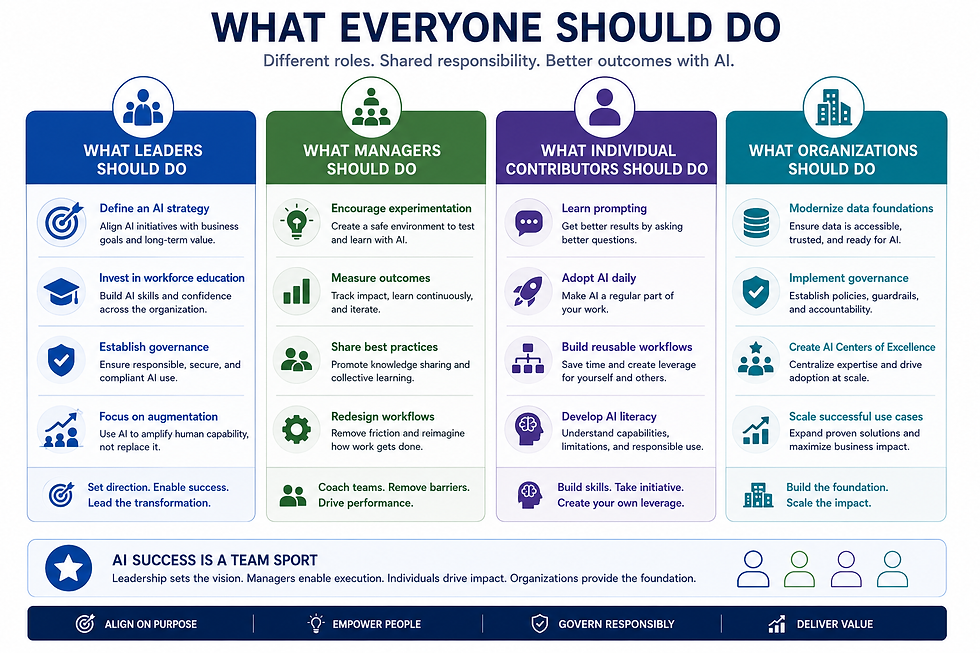
The organizations that realize the greatest value from AI will not necessarily be those that invest the most in technology. They will be the organizations that effectively align leadership, management, employees, processes, and governance around a shared vision for AI adoption.
Success requires action at every level of the organization.
What Leaders Should Do
Executives play a critical role in setting direction, allocating resources, and creating the conditions for successful adoption.
Define an AI Strategy
Establish a clear vision for AI across the organization.
Align AI initiatives with business objectives.
Prioritize high-value use cases and measurable outcomes.
Invest in Workforce Education
Provide AI training across all levels of the organization.
Develop prompt engineering, AI literacy, and automation skills.
Encourage continuous learning and adaptation.
Establish Governance
Define policies, controls, and accountability structures.
Ensure responsible, secure, and compliant AI usage.
Create frameworks for risk management and oversight.
Focus on Augmentation
Position AI as a capability multiplier, not simply a cost-reduction tool.
Emphasize productivity, innovation, and employee enablement.
Build trust through transparency and responsible adoption.
What Managers Should Do
Managers serve as the bridge between strategy and execution.
Encourage Experimentation
Create opportunities for teams to explore AI tools.
Promote learning through practical application.
Support innovation while maintaining appropriate controls.
Measure Outcomes
Track productivity improvements and business impact.
Identify successful use cases and lessons learned.
Focus on measurable value creation.
Share Best Practices
Capture successful prompts, workflows, and approaches.
Promote collaboration across teams.
Reduce duplication of effort.
Redesign Workflows
Reevaluate processes with AI in mind.
Remove unnecessary manual activities.
Integrate AI into day-to-day operations where appropriate.
What Individual Contributors Should Do
Every knowledge worker can begin building AI capabilities today.
Learn Prompting
Develop the ability to communicate effectively with AI.
Provide clear context, objectives, constraints, and desired outcomes.
Treat prompting as a professional skill.
Adopt AI Daily
Use AI for research, writing, analysis, planning, and problem-solving.
Build familiarity through regular use.
Continuously refine techniques and workflows.
Build Reusable Workflows
Create repeatable prompts and processes.
Capture successful approaches for future use.
Increase consistency and efficiency.
Develop AI Literacy
Understand AI capabilities and limitations.
Learn when human judgment is required.
Stay informed as technologies continue to evolve.
What Organizations Should Do
Sustainable success requires organizational capabilities, not isolated experimentation.
Modernize Data Foundations
Improve data quality, accessibility, and governance.
Establish trusted information sources.
Enable secure access to enterprise knowledge.
Implement Governance
Define policies, controls, and oversight mechanisms.
Address security, privacy, compliance, and ethical considerations.
Maintain transparency and accountability.
Create AI Centers of Excellence
Establish dedicated teams to guide adoption.
Share expertise, standards, and best practices.
Accelerate organizational learning.
Scale Successful Use Cases
Move beyond pilots and proofs of concept.
Replicate proven solutions across functions.
Focus investments on measurable business value.
Key Takeaway
AI adoption is not primarily a technology challenge—it is a leadership, workforce, and organizational transformation challenge.
Organizations that develop the right strategy, educate their workforce, establish strong governance, and systematically scale successful use cases will be best positioned to unlock the full potential of AI.
The opportunity belongs to organizations that learn fastest, adapt quickest, and most effectively combine human expertise with artificial intelligence.
Closing Thoughts
History suggests that platform shifts reward those who adapt early.
The Internet transformed access to information.
Mobile transformed access to technology.
Cloud transformed access to computing.
Artificial Intelligence is transforming access to intelligence itself.
The organizations that thrive over the next decade will not be those that simply deploy AI tools. They will be those that redesign work around human and artificial intelligence working together.
The future will belong to organizations that combine:
Human creativity
Human judgment
Human empathy
AI speed
AI scale
AI consistency
The ultimate opportunity is not to build organizations with fewer people. It is to build organizations where every person is dramatically more capable than they were before.
AI is not replacing the workforce. It is redefining what the workforce can achieve. The future is not fewer people. The future is more capable people.


Comments